3D Hexagon Infographic: A Modern Tool for Visual Communication and Business Presentations
The 3D Hexagon Infographic is a powerful visual tool that combines the geometric precision of a hexagon with the depth and dimensionality of 3D design. This type of infographic is ideal for conveying complex information in an engaging and easy-to-digest format. Whether you're presenting data, outlining a business process, or creating a marketing concept, the 3D Hexagon Infographic offers a modern, professional look that can elevate your content.
With its clean lines, symmetrical structure, and vibrant color schemes, this infographic style is particularly effective for digital media, web design, and print materials such as brochures, annual reports, and presentations. It supports a wide range of themes, from abstract concepts to detailed workflow diagrams, making it a versatile choice for various industries.
Understanding the 3D Hexagon Infographic
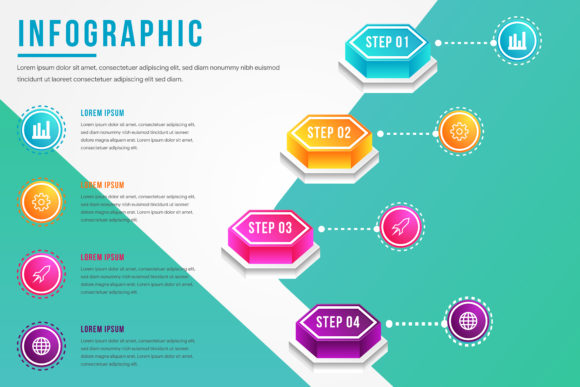
A hexagon is a six-sided polygon known for its balance and symmetry. When transformed into a 3D format, it gains an added layer of visual interest and spatial depth. The 3D Hexagon Infographic uses this shape as a framework to organize information, often breaking it down into four key sections or steps. This structure makes it particularly useful for illustrating processes, strategies, or multi-faceted ideas.
The design typically includes elements like icons, charts, graphs, and text, all arranged within the hexagonal layout. These components are often rendered in vector format, allowing for scalability without loss of quality. The use of gradients, such as green and blue backgrounds, adds a modern aesthetic while maintaining readability.
Because of its structured yet creative nature, the 3D Hexagon Infographic is well-suited for both digital and print applications. It can be used as a banner, background, or standalone graphic to support communication, marketing, or educational content.
Challenges and Goals Addressed by 3D Hexagon Infographics
Many professionals face challenges when trying to present complex data or concepts in a clear and visually appealing way. Traditional methods may lack engagement or fail to convey the intended message effectively. The 3D Hexagon Infographic addresses these issues by offering a structured, visually dynamic format that simplifies even the most intricate topics.
Whether you're working on a business report, a marketing campaign, or a presentation, the need for clarity and impact is essential. The 3D Hexagon Infographic helps meet these goals by organizing information into digestible parts. Its four-part structure allows for a logical flow, making it easier for audiences to follow along and understand the content.
Additionally, the use of colors like green, blue, orange, and purple can evoke specific emotions or associations. For instance, green might be used to represent growth or sustainability, while blue conveys trust and professionalism. This flexibility in color choice ensures that the infographic aligns with the brand identity and message of the user.
Practical Applications and Outcomes
The 3D Hexagon Infographic can be applied across multiple industries and scenarios. In business, it's commonly used to illustrate workflows, project timelines, or strategic planning. In education, it can help break down complex subjects into manageable parts. In marketing, it serves as an effective tool for showcasing product features, customer journeys, or campaign strategies.
One practical application is in the creation of annual reports. By using a 3D Hexagon Infographic, companies can present financial data, market trends, and future goals in a visually compelling manner. Similarly, in web design, it can be used as a background element or part of a website's layout to enhance user experience and navigation.
Another common use is in presentations. Whether you're pitching an idea to stakeholders or explaining a new product to clients, the 3D Hexagon Infographic provides a clear, structured way to communicate your message. It can also be used in digital banners, social media posts, or email campaigns to capture attention and deliver key messages quickly.
How Different Users Can Approach the Topic
Depending on the user's needs and expertise, there are several ways to approach the creation and implementation of a 3D Hexagon Infographic. Designers and marketers may choose to use pre-made templates available in graphic resources libraries. These templates provide a ready-made structure that can be customized with relevant data, icons, and colors.
For those with more technical skills, designing a custom 3D Hexagon Infographic using software like Adobe Illustrator or Blender can offer greater control over the final output. This approach allows for precise adjustments to the layout, color scheme, and 3D effects.
Regardless of the method chosen, it's important to focus on the end goal: delivering a clear, engaging message. This means ensuring that the infographic is not only visually appealing but also easy to understand. The use of consistent typography, readable fonts, and appropriate iconography plays a crucial role in achieving this.
Moreover, considering the audience is key. If the infographic is intended for a professional setting, the design should reflect a formal tone. On the other hand, if it's meant for a younger or more casual audience, a more vibrant and colorful approach may be more effective.
Useful Considerations and Recommendations
When creating a 3D Hexagon Infographic, there are several considerations that can help ensure its effectiveness. First, it's important to define the purpose of the infographic clearly. Is it meant to inform, persuade, or entertain? This will influence the content, design, and overall approach.
Next, choosing the right tools and resources is essential. There are many online platforms and graphic design tools that offer templates, icons, and vectors specifically designed for infographics. These can save time and effort, especially for those who are new to infographic design.
Another recommendation is to keep the design simple and focused. While the 3D effect adds visual interest, it shouldn't overshadow the content. The information should be the primary focus, with the design serving as a supporting element.
Finally, testing the infographic with a sample audience can provide valuable feedback. This helps identify any potential issues with clarity, readability, or visual appeal before the final version is shared publicly.
In conclusion, the 3D Hexagon Infographic is a versatile and effective tool for visual communication. Whether you're a designer, marketer, or business professional, incorporating this style into your work can enhance your ability to convey complex information in a clear and engaging way. With the right approach and considerations, it can become a valuable asset in your design toolkit.